
Dry Van Equipment & Compliance
Truck Axle Weight Limits and Load Distribution Guide
An 80,000-pound gross weight does not make a load legal by itself. Every axle group, spacing measurement, equipment rating, and route restriction still matters.
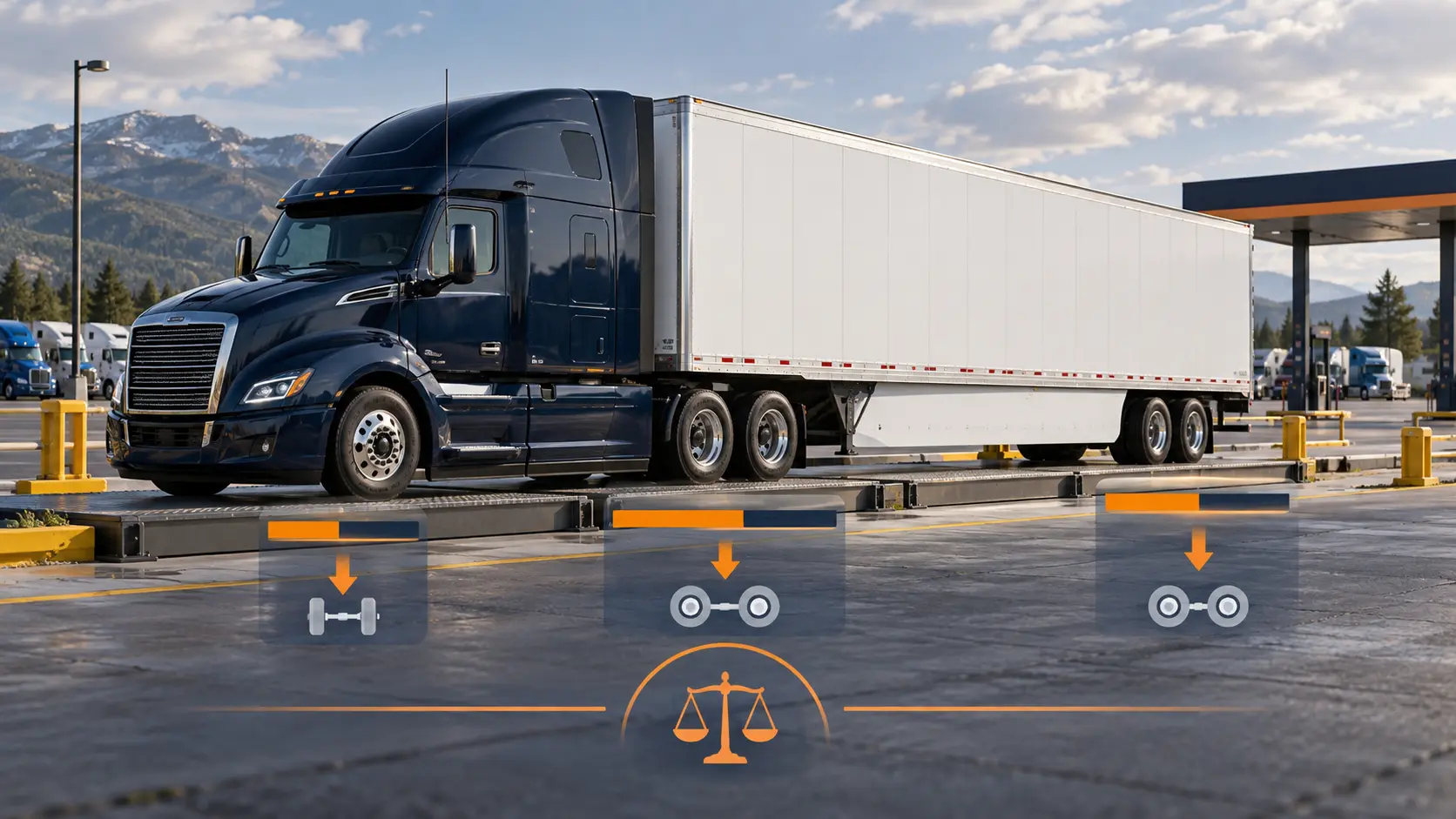
A scale ticket separates a tractor-trailer's weight into steer, drive, and trailer axle groups. The total may look acceptable while one tandem is overweight, or the axle groups may look acceptable while axle spacing fails the Federal Bridge Formula. The reliable workflow is to know the applicable route limits, scale the complete combination, correct the distribution, secure the cargo, and reweigh.
This article covers a common five-axle tractor and 53-foot dry van in ordinary operation. It is general information, not legal advice or a permit determination. State and local limits, posted bridges, load-zoned roads, tire and axle ratings, registration, permits, commodity exceptions, and specific equipment can impose different or lower limits.
Federal Interstate starting points
| Measure | General federal maximum | Important qualification |
|---|---|---|
| Gross vehicle weight | 80,000 lb | Bridge Formula or another applicable rule may require less |
| Single axle | 20,000 lb | Tire, axle, vehicle, registration, state, or route limits may be lower |
| Tandem axle group | 34,000 lb | Applies to the federal tandem definition and does not override Bridge Formula checks |
| Any group of 2+ consecutive axles | Bridge Formula | Number of axles and distance between the outer axles control |
1. The familiar 12/34/34 pattern is not the whole law
Drivers often describe a standard five-axle combination as 12,000 pounds on the steer, 34,000 on the drives, and 34,000 on the trailer tandems. That totals 80,000 pounds and is a useful planning pattern—but 12,000 is not a universal federal steer-axle limit.
FHWA's current Bridge Formula guide states that the federal Interstate limits are 20,000 pounds for a single axle, 34,000 pounds for a tandem, and 80,000 pounds gross. The actual legal steer weight can still be limited by tires, wheels, axle and suspension ratings, manufacturer ratings, vehicle registration, state law, or a specific road or bridge. Never add weight to the steer axle merely because 20,000 appears in the federal rule.
Texas publishes the same ordinary legal starting limits—80,000 gross, 20,000 on a single axle, and 34,000 on a tandem—while also directing users to its permissible-weight table. Other jurisdictions and non-Interstate routes must be checked separately.
2. Understand what the Bridge Formula checks
The Federal Bridge Formula limits how much weight can be concentrated across a given axle span. FHWA explains that spacing weight over more axles or a longer distance reduces stress on bridges. The formula is:
W is the maximum weight in pounds for the axle group, L is the distance in feet between the outer axles, and N is the number of axles in the group. The calculation applies to groups of two or more consecutive axles—not only the entire truck.
On a typical five-axle tractor-semitrailer, FHWA identifies the steer-through-drive group, the full five-axle outer bridge, and the drive-through-trailer group as commonly critical checks. FHWA also notes an exception allowing two consecutive tandem sets to carry 34,000 pounds each when the distance from the first axle of the first tandem to the last axle of the second tandem is at least 36 feet.
Use the current FHWA Bridge Formula guide and table, plus the rules for every jurisdiction and route. Do not assume that sliding the trailer tandems to reach 34,000 pounds automatically makes the inner and outer bridge groups legal.
3. Calculate payload before the shipper loads
Payload capacity starts with the truck's actual ready-to-load weight, not a brochure's advertised empty weight. Scale the tractor and empty trailer with the normal driver, fuel, DEF, tools, chains, dunnage, load bars, spare equipment, and other items normally carried.
Ready-to-load tare
Actual scaled tractor, trailer, fuel, driver, and operating equipment.
Theoretical gross payload
Applicable gross limit minus ready-to-load tare.
Axle-limited payload
The lower capacity created by steer, drive, trailer, tire, or Bridge Formula limits.
Route-limited payload
Any lower posted, state, local, bridge, or permit restriction on the planned route.
The smallest of these limits controls. A combination that weighs 33,500 pounds empty does not automatically have 46,500 pounds of usable payload: the cargo's shape and position may overload a tandem before the vehicle reaches 80,000 pounds.
4. Read the scale ticket as three separate problems
Use a certified scale that reports steer, drive, trailer, and gross weights. Position each axle group completely on the correct platform, keep the vehicle straight, set the brakes as instructed, and follow the scale operator's procedure. Compare the ticket with all applicable limits and ratings.
- 1
Confirm the gross
If gross weight exceeds the applicable limit, sliding axles cannot remove weight; freight or other weight must be removed unless a valid permit or exception applies.
- 2
Check each axle group
Compare steer, drives, and trailer tandems with legal limits and equipment ratings.
- 3
Check axle spacing
Verify the tandem position and Bridge Formula groups for the route.
- 4
Preserve the ticket
Save the original scale record with the load documents and note any adjustment and reweigh.
Allow for changes after scaling. Additional fuel, a passenger, equipment, snow or ice accumulation, or cargo movement can alter gross or axle weights. When margins are tight, scale in the condition in which the truck will actually travel.
5. Know what each adjustment changes
Sliding the trailer tandems forward generally transfers weight from the tractor drives to the trailer tandems. Sliding them rearward generally transfers weight from the trailer tandems to the drives. It also changes axle spacing, rear swing, off-tracking, and compliance with state tandem-position or bridge requirements.
Moving a sliding fifth wheel forward generally transfers weight from the drive axles to the steer axle; moving it rearward generally transfers weight from the steer axle to the drives. Fifth-wheel position can also affect tractor-trailer clearance and handling. Adjust it only under the carrier's procedure and the equipment manufacturer's instructions.
A commonly repeated pounds-per-hole estimate is not reliable enough for compliance. Hole spacing, suspension geometry, load position, trailer design, and equipment configuration change the result. Make one controlled adjustment, lock every pin, visually verify engagement, perform the required tug and safety checks, then reweigh.
6. Treat cargo placement as the first adjustment
A concentrated load near the trailer nose can overload the drives; a load concentrated far rearward can overload the trailer tandems and reduce tractor loading. Pallet count alone is not enough because identical-looking pallets can have very different weights.
Before loading, provide the shipper with accurate equipment dimensions and request the total weight, individual pallet or item weights, loading sequence, and any special securement instructions. If the distribution cannot be corrected safely with normal axle adjustments, return to the dock for a reload or removal. Do not rely on driving to “settle” freight into compliance.
After repositioning freight, restore the required blocking, bracing, straps, bars, or other securement. Under 49 CFR §392.9, drivers generally must inspect cargo and securement within the first 50 miles and reexamine after specified duty-status or distance/time events. Sealed or inaccessible loads have limited exceptions, but a seal does not waive weight compliance.
7. Use a safe axle-adjustment workflow
- Move to a level, designated adjustment area away from traffic.
- Set brakes and follow the tractor and trailer manufacturer's procedures.
- Confirm the trailer tandem pins are fully retracted before sliding and fully engaged afterward.
- Check airlines, electrical cable, landing gear, mudflaps, tire clearance, and tractor-trailer clearance.
- Do not exceed legal tandem-position, wheelbase, kingpin, bridge, or overall-length restrictions.
- Recheck cargo securement after any meaningful movement or dock reload.
- Reweigh the complete combination; do not estimate the final result.
- Keep the scale and reweigh tickets with the load record.
8. Resolve an overweight ticket before leaving
If gross weight is legal but one tandem is heavy, determine whether the load can be corrected through a safe tandem or fifth-wheel adjustment within every other limit. If the adjustment would overload another axle, violate spacing, exceed equipment ratings, or create a clearance problem, the freight must be redistributed or reduced.
If gross weight itself is over the applicable limit, contact dispatch and the broker or shipper immediately. Document the scale result and request written loading instructions. Do not accept a promise that “it always passes” or that a rate confirmation's listed weight controls over the scale.
A reload can affect appointment time, hours of service, parking, detention, and route planning. Use the accessorial-fees guide to document delay and approval requirements, and the truck-parking guide to recalculate the safe stopping plan.
Final pre-departure weight checklist
- Commodity, total weight, pallet or item weights, and loading method match the tender.
- Ready-to-load tare includes the driver, fuel, DEF, tools, dunnage, and operating equipment.
- Steer, drive, trailer, and gross weights are shown on a certified scale ticket.
- Federal, state, local, posted-route, registration, permit, and equipment limits were checked.
- Bridge Formula and required axle spacing are satisfied.
- Trailer tandems and fifth wheel are within approved positions and all pins are engaged.
- Cargo is distributed and secured for braking, turning, and normal road forces.
- Any adjustment was followed by inspection and reweigh.
- The scale record and shipper communications are stored with the load file.
Weight compliance is a repeatable operating process: know the route, know the tare, scale, compare, correct, secure, reweigh, and document. That process protects the equipment, schedule, freight, and carrier record better than relying on a single 80,000-pound total.
Official sources
- FHWA Bridge Formula Weights — federal Interstate axle, tandem, gross, spacing, and axle-group guidance.
- 23 CFR §658.17 — federal weight regulation.
- Texas Size and Weight Limits — Texas legal limits, permissible-weight resources, permits, and exceptions.
- 49 CFR §392.9 — cargo inspection and securement responsibilities.
Sources and regulations reviewed September 16, 2026. Verify current requirements for the specific vehicle, load, permit, and route before movement.