
Texas Carrier Compliance
Texas IFTA Filing Guide: Q3 2026 Deadline and Recordkeeping Checklist
A practical system for tracking jurisdiction miles, protecting fuel-tax credits, reconciling a quarter, and keeping a one-truck carrier ready for an audit.
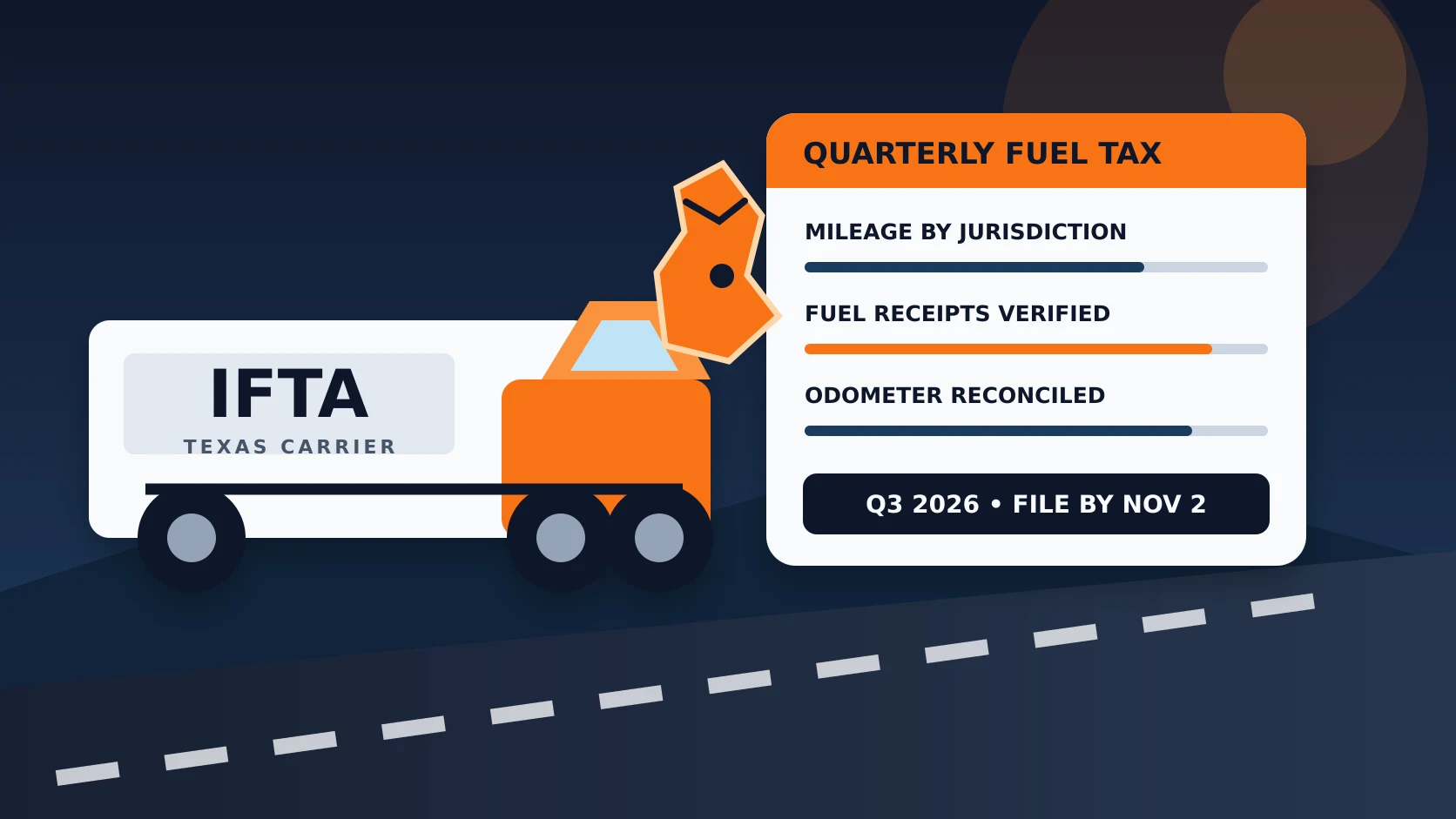
IFTA is easier when the carrier treats it as a weekly recordkeeping process—not a quarterly search for missing receipts. Texas-based interstate carriers use one return to report qualified-vehicle fuel and distance across member jurisdictions. The return reconciles where the truck traveled with where fuel tax was paid; it is not simply a report of how many gallons were purchased in Texas.
For the 2026 third quarter, the reporting period ends September 30. The normal due date, October 31, falls on a Saturday, so the Texas Comptroller's weekend rule moves the deadline to the next business day: Monday, November 2, 2026. Filing early leaves time to correct a missing jurisdiction or unreadable receipt.
Texas IFTA calendar at a glance
| Quarter | Activity period | Usual deadline |
|---|---|---|
| Q1 | January 1–March 31 | April 30 |
| Q2 | April 1–June 30 | July 31 |
| Q3 | July 1–September 30 | October 31* |
| Q4 | October 1–December 31 | January 31* |
*When the due date is a Saturday, Sunday, or legal holiday, Texas treats the next business day as the deadline. Q3 2026 is therefore due November 2, 2026.
1. Confirm whether the truck is an IFTA-qualified vehicle
Under the 2026 IFTA Articles of Agreement, a commercial vehicle used to transport people or property is a qualified motor vehicle when it has two axles and exceeds 26,000 pounds gross or registered gross weight, has three or more axles regardless of weight, or operates as a combination exceeding 26,000 pounds. The licensing requirement generally applies when that qualified vehicle operates in two or more IFTA jurisdictions.
A typical interstate tractor-trailer qualifies. A carrier should not decide based only on the weight of one load; registered configuration, axle count, combined weight, base jurisdiction, and operating territory matter. Texas says qualifying commercial vehicles traveling in more than one state or Canadian province must report through IFTA.
2. Understand what the return is reconciling
IFTA distributes fuel-use tax among jurisdictions. The carrier reports total fleet distance, distance by jurisdiction, and fuel placed into qualified vehicles. The calculation develops a fleet fuel-consumption factor and applies each jurisdiction's current rate. Tax-paid fuel purchased in a jurisdiction can produce a credit against the tax attributable to travel there; buying fuel in one state does not erase the liability created by traveling in another.
Do not estimate tax from pump price alone. Each jurisdiction sets its own rate, and the correct quarter's rates should be used. The Texas Comptroller links carriers to the official IFTA rate matrix and provides electronic filing through Webfile.
3. Capture every mile—not only loaded miles
IFTA distance is not the same as broker-paid mileage. Total distance includes the qualified fleet's travel during the reporting period, while jurisdiction records allocate those miles by state or province. Deadhead, repositioning, shop trips, and personal-conveyance movement do not disappear merely because a broker did not pay for them. Any claimed exempt distance should be documented and reported according to the jurisdiction's rules.
For a trip-based record created without a qualifying vehicle-tracking system, retain:
- Beginning and ending trip dates
- Origin and destination
- Route of travel
- Beginning and ending odometer or ECM readings
- Total trip distance
- Distance traveled in each jurisdiction
- VIN or vehicle-unit number
Reconcile state mileage to total odometer movement. The sum of jurisdiction miles should equal the trip total, and the quarter's trip totals should reconcile with opening and closing mileage after documented adjustments.
4. Do not assume an ELD PDF is automatically audit-ready
A vehicle-tracking system can support IFTA, but the 2026 Procedures Manual sets specific minimum data requirements. When the engine is on, the system must create and retain a reading at least every 10 minutes, including date and time, latitude and longitude to four decimal places, ECM odometer reading, and VIN or unit number. If ECM mileage is unavailable, beginning and ending dashboard or hubodometer data may be accepted for the trip.
Critically, the tracking data must be available in an electronic spreadsheet format such as XLS, XLSX, CSV, or delimited text. The manual says static PDF, JPEG, PNG, or Word exports are not acceptable for this vehicle-tracking dataset. Before relying on an ELD or telematics subscription, test the export and confirm it covers the full quarter—not only the last few days visible in the app.
5. Protect every tax-paid fuel credit
Keep complete fuel records for all fuel purchased, received, or used. A bank or fuel-card statement can help reconcile charges, but it may not contain every field required for tax-paid credit. The IFTA Procedures Manual allows receipts, invoices, seller transaction listings, credit-card receipts, and electronic or digital copies of original receipts when the documentation is valid.
A qualifying retail record should show:
Purchase details
Date, seller name and address or identified vendor code, fuel quantity, fuel type, and price per volume or total price.
Carrier and vehicle
Identification of the qualified vehicle and the purchaser name with a legal connection to the IFTA licensee.
Readable evidence
An unaltered, legible original or valid electronic record. An illegible or unexplained altered receipt can lose the credit.
Complete fuel total
Track fuel placed in the truck even when a tax-paid receipt is missing; missing proof affects the credit, not the need to account for fuel used.
Photograph paper receipts promptly, verify the gallons and unit number, and file them by transaction date. Retain the detailed fuel-card export as well as the image; the two records make duplicate, reversed, and missing transactions easier to find.
6. Use a monthly close instead of waiting for quarter-end
- 1
Lock the mileage period
Use a consistent cutoff for fuel and distance. Record the truck's opening and closing odometer or ECM values.
- 2
Export jurisdiction distance
Download the ELD or telematics file in an auditable spreadsheet format and save the raw export unchanged.
- 3
Reconcile trips
Compare routes, dispatch records, bills of lading, toll activity, and location history. Investigate gaps and duplicate miles.
- 4
Reconcile fuel
Match receipts to the fuel-card statement, flag missing documents, and confirm gallons, fuel type, purchaser, and unit.
- 5
Create a monthly summary
Summarize fuel placed into each vehicle and distance traveled by vehicle, in total and by jurisdiction.
- 6
Review fleet MPG
A large change may indicate omitted gallons, duplicated miles, a wrong unit, or a boundary-allocation problem. Investigate rather than forcing the number.
The IFTA manual notes that monthly fleet summaries may be necessary for an efficient audit. For a one-truck carrier, a monthly close also prevents three months of small errors from becoming one large reconstruction project.
7. File the Texas return even when no tax appears due
A licensee should follow Texas filing requirements for every reporting period. A quarter with no operations or no net tax is not permission to ignore the return. In Webfile, review the reporting period, fleet fuel type, total and jurisdiction distance, tax-paid gallons, calculated MPG, applicable rates, credits, and amount due before submitting. Save the confirmation, filed return, schedules, and proof of payment.
The Texas Comptroller states that returns are due on the last day of the month after each quarter. As of September 5, 2026, Texas lists a late-filing, late-payment, or underpayment penalty of $50 or 10% of delinquent tax, whichever is greater. It also lists interest at 9% annually and 0.75% per month or fraction of a month on delinquent tax. Verify the current figures before filing because agencies can update rates and procedures.
8. Keep an audit-ready folder for four years
The 2026 IFTA Procedures Manual requires records to be retained for four years after the return due date or filing date, whichever is later, plus any period covered by waivers or jeopardy assessments. Records for an audited period must remain available. The licensee carries the burden of proof, so an unsupported number can become an expensive problem even when the original trip was legitimate.
A practical folder structure for each quarter includes:
Filed return
Return, jurisdiction schedules, payment confirmation, notices, and amendments.
Raw mileage data
Original spreadsheet export, odometer records, trip sheets, routes, and jurisdiction summaries.
Fuel evidence
Receipt images, detailed vendor export, fuel-card statement, missing-receipt log, and bulk records if applicable.
Supporting operations
Dispatch records, rate confirmations, BOLs, PODs, toll statements, repair travel, and unit-assignment records.
9. Avoid the mistakes that distort a one-truck return
- Reporting only loaded miles: IFTA total distance is broader than billable distance.
- Using dispatch miles as actual distance: rate-confirmation mileage may not match the route driven.
- Leaving out fuel with no receipt: fuel still belongs in the consumption calculation even if tax-paid credit cannot be documented.
- Keeping only screenshots: vehicle-tracking data must be exportable in the required auditable format.
- Combining units incorrectly: mileage and fuel must remain traceable to the qualified vehicle and reporting fleet.
- Waiting until the due date: missing state miles, unreadable receipts, and account-access problems take time to correct.
The bottom line for Texas owner-operators
The best IFTA system is a repeatable chain: record every mile, preserve every gallon, export usable data, reconcile monthly, file on time, and retain the complete evidence. For Q3 2026, Texas carriers should close records through September 30 and plan to file by November 2, 2026.
For professional dry-van freight service with ONENESS TRANSPORT LLC, call 512-363-3649 or email dispatch@onenesstransport.com.
Official materials were reviewed September 5, 2026. This article provides general information, not tax, accounting, or legal advice. Confirm the current rules, rates, exemptions, filing fields, and deadlines with the Texas Comptroller or a qualified tax professional for your operation.