Inspection & Compliance News
2026 CVSA Roadcheck Results: What Carriers Should Fix
The newest North American inspection data shows where trucks and drivers were placed out of service—and where a small carrier should focus next.
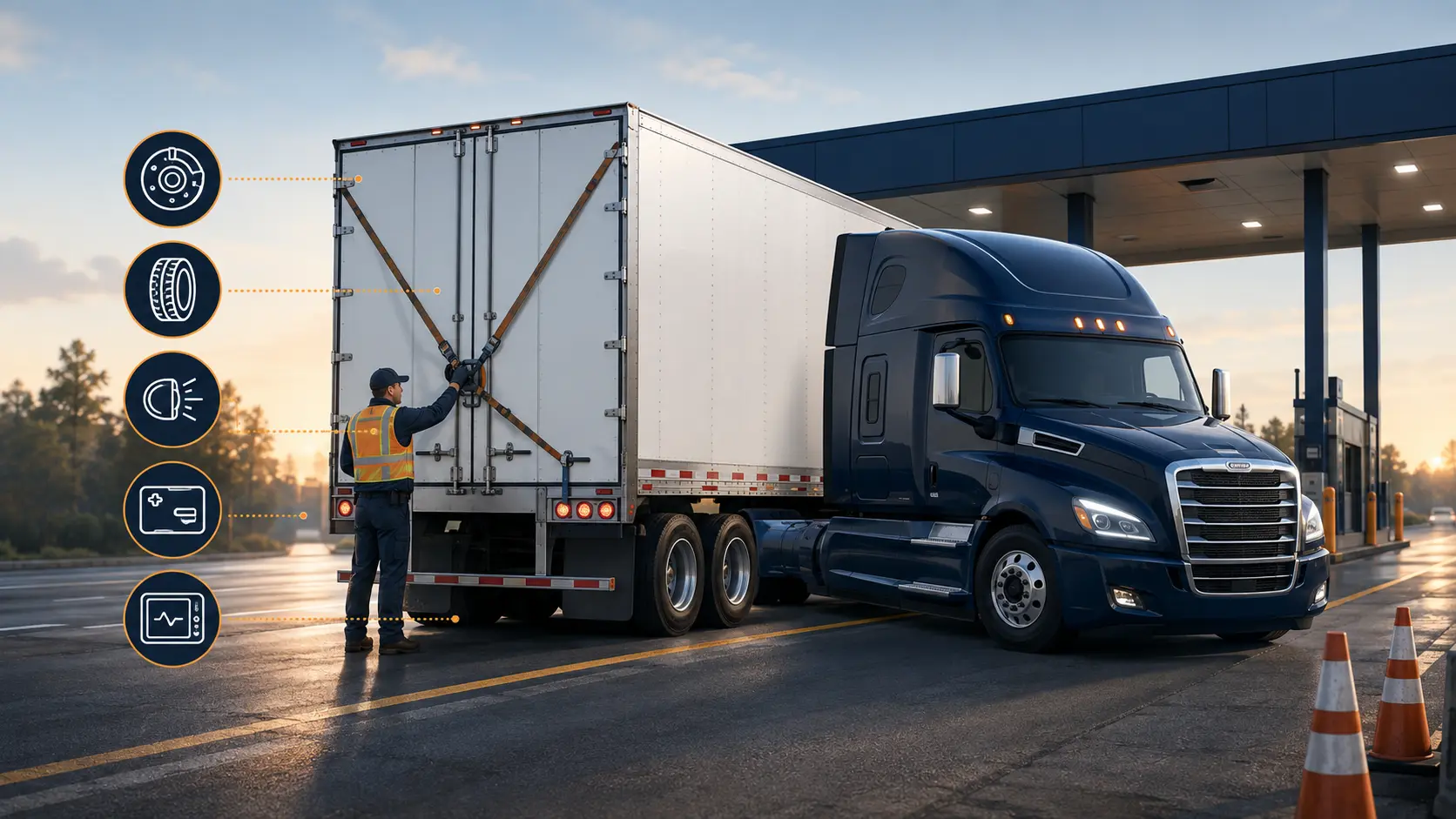
CVSA released the results of its 2026 International Roadcheck on August 25. During the May 12–14 enforcement initiative, inspectors completed 54,575 inspections across the United States, Canada, and Mexico. Most inspected vehicles and drivers had no out-of-service violation, but the results identify recurring risks that carriers can address before the next roadside inspection.
This article separates inspection counts from violation counts, explains the cargo-securement and ELD focus areas, and converts the findings into practical steps. An out-of-service order is more serious than a routine violation: the affected vehicle or driver cannot continue until the disqualifying condition is corrected or brought into compliance.
2026 International Roadcheck at a glance
| Measure | Result | What it means |
|---|---|---|
| Total inspections | 54,575 | Driver and vehicle inspections conducted across North America |
| Vehicle inspections (Levels I, II and V) | 44,047 | 10,350 vehicles or combinations were placed out of service: 23.5% |
| Driver inspections (Levels I, II and III) | 53,271 | 3,184 drivers were placed out of service: 6.0% |
| CVSA decals | 17,680 | Eligible U.S. and Canadian vehicles passed without critical mechanical or OOS violations |
| Cargo-securement OOS violations | 1,724 | 12.4% of the 13,924 vehicle OOS violations found |
| ELD-tampering OOS orders | 146 | 3.7% of reported driver OOS violations; seventh-ranked driver OOS category |
A single vehicle or driver can have multiple violations. Violation-category percentages are shares of out-of-service violations—not the percentage of all trucks on the road.
1. The vehicle out-of-service rate deserves attention
Among the 44,047 Level I, II, and V inspections that involved vehicles, 10,350 vehicles or combinations were placed out of service—a 23.5% rate. Inspectors recorded 13,924 vehicle out-of-service violations because one vehicle may have more than one disqualifying condition.
This was an enforcement event, not a random scientific sample of every commercial vehicle. Inspection locations, selection practices, carrier mix, and regional operations can affect the results. A carrier should not treat 23.5% as its predicted inspection outcome. The useful lesson is that critical defects were common enough to justify disciplined pre-trip checks and documented maintenance.
2. Brakes remained the largest vehicle problem
Brake-system violations were the largest category, with 3,379 out-of-service violations, or 24.3% of all vehicle OOS violations. CVSA separately recorded 2,072 violations under the 20%-defective-brakes criterion. Together, those two brake categories represented 5,451 violations—39.1% of all vehicle OOS violations found during the event.
For carriers, the response should extend beyond checking whether the truck stops. Inspect air lines and chambers, listen for leaks, monitor warning devices, look for contamination and missing or damaged components, and have qualified personnel verify adjustment and lining or pad condition. Trailer brakes belong in the same program as tractor brakes.
Our Brake Safety Week checklist gives a more detailed tractor-and-trailer workflow. Drivers should report defects promptly, and a carrier should not dispatch equipment with an unresolved condition that affects safe operation.
3. Tires were the second-largest OOS category
Inspectors identified 2,914 tire-related out-of-service violations, equal to 20.9% of vehicle OOS violations. A practical tire check includes inflation, tread, cuts, exposed cord, bulges, sidewall damage, objects, mismatched duals, valve stems, and evidence of contact or rubbing. The carrier must also confirm that tires are appropriate for their position and load.
Inspect the inside dual and trailer tires instead of viewing only the easiest side. Heat, underinflation, and irregular wear often reveal alignment, suspension, bearing, or brake problems. Record pressure and damage trends so a repeated issue leads to diagnosis rather than another roadside replacement.
4. Cargo securement was the event’s vehicle focus
CVSA counted 1,724 cargo-securement out-of-service violations—12.4% of the 13,924 vehicle OOS violations. Cargo securement ranked fourth across North America and fifth in the United States. The category covers freight that is not adequately restrained, immobilized, locked, tied down, packed, or monitored.
A closed dry van does not automatically make every load secure. Federal rules require cargo to be contained, immobilized, or secured so it cannot leak, spill, blow, fall, or shift enough to affect stability or maneuverability. Trailer walls, floors, anchor points, straps, bars, dunnage, and other components used as part of the securement system must be strong enough and free from damage that weakens performance.
Before leaving, verify weight distribution, axle limits, pallet condition, void space, blocking and bracing, strap or load-bar condition, anchor-point integrity, and door closure. Commodity-specific rules may apply—for example, to certain metal coils or paper rolls—so a general pallet procedure is not enough for every load.
5. The first 50 miles matter—and so do rechecks
Under 49 CFR §392.9, a driver generally must inspect cargo and securement within the first 50 miles and make necessary adjustments. The driver must reexamine when changing duty status, after three hours of driving, or after 150 miles, whichever occurs first.
The rule includes exceptions when a sealed vehicle may not be opened or cargo is loaded so inspection is impracticable. A seal does not justify guessing. The driver should document the seal number and shipper restriction, inspect what is accessible, check doors and external equipment, and report a suspected shift or safety problem through dispatch.
6. Lights remain a high-frequency inspection issue
CVSA recorded 1,659 lighting-related out-of-service violations, or 11.9% of vehicle OOS violations. Walk around the complete combination with lamps activated: tail, stop, turn, clearance, identification, side marker, license-plate, and required reflective material. Check pigtail seating, wiring, lenses, mounting, corrosion, and intermittent faults.
A functioning light can still be noncompliant if it is obscured by dirt, cargo, equipment, or damage. Verify the trailer after coupling and again after loading because dock contact, wiring movement, and door operation can change the condition.
7. Driver files caused thousands of OOS findings
Of 53,271 Level I, II, and III driver inspections, 3,184 drivers were placed out of service. CVSA listed no medical card as the top driver OOS category, with 1,072 violations, followed by hours of service with 929 and no commercial driver's license with 620.
Medical certification may be electronically linked to a CDL record, but drivers and carriers should still verify the state record, expiration, license status, class, endorsements, and restrictions before dispatch. Build alerts far enough ahead of expiration to allow for an examination, state processing, and correction of any mismatch.
For a broader carrier-file review, use our FMCSA New Entrant safety-audit checklist.
8. ELD tampering was a focus—but not the top OOS category
Inspectors issued 146 out-of-service orders associated with ELD tampering, falsification, or manipulation. CVSA says this represented 3.7% of driver OOS violations and ranked seventh among driver OOS categories. Hours-of-service violations and false records of duty status also appeared separately in the results.
Do not overstate the result: 146 OOS orders do not show that 3.7% of all inspected drivers tampered with an ELD. The denominator is reported driver OOS violations, and one driver may have multiple violations.
Carriers should train drivers to certify logs, handle edits transparently, annotate legitimate corrections, manage unassigned driving, and transfer records during an inspection. Dispatch practices must not encourage a driver to conceal driving time or exceed available hours. Also confirm that the device remains on FMCSA's registered list; see our revoked-ELD replacement guide.
9. What an inspector may examine
CVSA describes a Level I inspection as a comprehensive driver-and-vehicle inspection. Depending on inspection level and applicability, items may include credentials, medical certification, record of duty status, seat belt, brakes, cargo securement, coupling devices, driveline, exhaust, frame, fuel system, lights, steering, suspension, tires, van body, wheels, rims, hubs, and wipers.
A Level II inspection is a walk-around examination and generally covers items that can be checked without physically going under the vehicle. A Level III focuses on the driver, credentials, and administrative requirements. A Level V is a vehicle-only inspection that can occur without a driver present.
Inspection levels help explain why the raw counts are not directly interchangeable. For example, Level III inspections do not produce a vehicle OOS rate because they do not include the mechanical vehicle inspection.
10. A practical seven-step carrier response
- 1
Audit recent roadside reports
Group violations by brake, tire, light, securement, driver credential, and ELD category. Look for repeat defects.
- 2
Inspect tractors and trailers together
A compliant tractor does not offset a defective trailer. Include leased and interchanged equipment in the dispatch check.
- 3
Standardize cargo questions
Before accepting, confirm commodity, packaging, weight, pallet count, dimensions, special securement, and sealed-load instructions.
- 4
Stock usable securement equipment
Remove cut or weakened straps, damaged bars, and unreliable dunnage. Match equipment and working-load limits to the cargo.
- 5
Verify driver status
Check CDL class, endorsements, restrictions, medical qualification, Clearinghouse status where required, and expiration alerts.
- 6
Review ELD exceptions and edits
Train with the actual device and written policy. Correct mistakes transparently rather than masking driving time.
- 7
Close the repair loop
Document the reported defect, qualified diagnosis, repair, return-to-service decision, and retained record. Do not rely on a verbal “fixed.”
Dry-van pre-dispatch checklist
Trailer exterior
Lights, conspicuity tape, doors, hinges, latches, roof, walls, frame, landing gear, underride protection, plate, and visible damage.
Running gear
Brakes, air lines, ABS indicator, tires, wheels, rims, hubs, suspension, axle area, and signs of leaks or heat.
Coupling
Fifth wheel, kingpin engagement, locking jaws, release handle, mounting, air/electrical connections, and tug test.
Cargo space
Floor, walls, roof, anchor points, odor, moisture, debris, nails, securement equipment, and load compatibility.
Loaded condition
Weight distribution, axle weights, voids, pallets, straps, bars, blocking, dunnage, doors, seal, and accessible rechecks.
Driver readiness
License, medical status, HOS availability, ELD function, permits, registration, insurance evidence, and inspection documents.
The bottom line for small carriers
The 2026 Roadcheck results do not say every truck faces the same risk. They do show that brakes, tires, cargo securement, lights, driver credentials, and hours records repeatedly produced conditions serious enough to stop operations. A short, documented inspection and repair routine protects safety, appointments, freight, and operating revenue.
For professional dry-van freight service with ONENESS TRANSPORT LLC, call 512-363-3649 or email dispatch@onenesstransport.com.
CVSA published the results August 25, 2026, for inspections conducted May 12–14, 2026. Regulations and guidance were reviewed September 4, 2026. This article is general information, not legal or compliance advice. Apply the rules to the specific vehicle, cargo, jurisdiction, and operation.